The clinical evidence behind Bentrio.
Bentrio is a drug-free barrier nasal spray. Its efficacy and safety have been investigated in randomised, controlled clinical studies in seasonal and perennial allergic rhinitis, including controlled allergen challenge chamber trials and a nasal retention study.
Strong efficacy in a 2-week study of seasonal allergic rhinitis.
In a randomised, controlled clinical study of 100 patients with seasonal allergic rhinitis in Australia, Bentrio achieved a strong reduction in the reflective Total Nasal Symptom Score (rTNSS) over a two-week treatment period. The rTNSS captures the worst severity of nasal congestion, sneezing, nasal itching and rhinorrhoea over the previous 24 hours. Patients self-treating with Bentrio reported a mean fall in rTNSS from 6.9 at baseline to 5.0 (−1.9 points), versus 6.9 to 6.1 (−0.8 points) for saline nasal spray – the current standard in drug-free allergy care.
Mean change in rTNSS over 2 weeks
Greater reduction is better. Difference statistically significant (p = 0.013; 95% CI −2.0 to −0.2).
2.4×
Greater reduction in nasal symptoms with Bentrio than saline nasal spray.
2.6×
More patients in the Bentrio group could go without rescue medication during treatment (69% vs 27%).
65.9%
of Bentrio patients rated the treatment good or very good, versus 28.5% for saline.
Across the NASAR study Bentrio significantly outperformed saline nasal spray, improving symptoms 2.1- to 3.5-fold. Health-related quality of life, measured with the Rhinoconjunctivitis Quality of Life Questionnaire (RQLQ), improved by 1.0 point more than saline from baseline to the end of the two-week study – a statistically significant and clinically relevant change, with significantly better results across all quality-of-life domains.
Consistent advantage across every measured outcome.
Beyond the overall rTNSS, the NASAR study assessed each individual nasal symptom, rescue-medication use, patient-rated efficacy and tolerability, and quality of life. Bentrio outperformed saline nasal spray across the board.
rTNSS reduction by symptom
Mean reduction in each symptom score. Higher is better.
Patient-rated efficacy
Share of patients in each efficacy rating.
Rescue-medication-free patients
Share of patients who needed no rescue medication during treatment. Higher is better.
RQLQ improvement at day 14
Mean improvement in quality of life. Higher is better.
69% vs 27%
Patients who needed no rescue medication during treatment – Bentrio versus saline nasal spray.
−2.2 vs +6
Mean change in rescue-medication use: it fell with Bentrio while rising with saline nasal spray.
Bentrio (green) versus saline nasal spray (grey). NASAR study, n = 100. Peer-reviewed.
Significant protection under controlled allergen exposure.
Perennial allergic rhinitis
In a three-way crossover study in Canada with 37 patients with house dust mite–driven perennial allergic rhinitis, Bentrio provided effective, statistically significant protection over 3 hours of exposure in a challenge chamber. Bentrio reduced the rise in mean TNSS by 1.1 points versus no treatment (p < 0.01; 95% CI −1.87 to −0.28): mean TNSS 4.1 with Bentrio versus 5.2 with no treatment.
Δ TNSS from baseline over 3 hours of exposure
Seasonal allergic rhinitis
In a controlled crossover study in Germany with 36 patients with grass pollen–driven seasonal allergic rhinitis, Bentrio provided effective, statistically significant protection over 4 hours of pollen exposure in a provocation chamber. Bentrio reduced the rise in mean TNSS by 1.09 points versus no treatment (p < 0.01; 95% CI −1.61 to −0.54): mean TNSS 4.82 with Bentrio versus 5.91 with no treatment.
Δ TNSS from baseline over 4 hours of exposure
Green line: Bentrio. Grey line: no treatment. Both studies peer-reviewed.
A protective film covering the nasal mucosa for up to 4 hours.
In a distribution and residence-time study with 8 subjects in Germany, fluorescent Bentrio was observed in the relevant inferior turbinate for 3.5 to 4 hours. A second spray at a different angle showed no significant difference, confirming a single spray is sufficient. By contrast, fluorescent saline nasal spray was observed for only 60 minutes. This long nasal residence time aligns well with the long protection duration seen in the challenge chamber studies.
Peer-reviewed.
Presence in the inferior turbinate
Fluorescent signal over time: Bentrio at two spray angles (green, blue) versus saline nasal spray (grey).
Read the original papers.
Every study presented on this page has been published in a peer-reviewed journal. Select a publication to open the full text at the publisher.
 Seasonal allergic rhinitis · NASAR
AM-301, a barrier-forming nasal spray, versus saline spray in seasonal allergic rhinitis: A randomized clinical trial
Allergy
Becker S, Deshmukh S, De Looze F, et al. Allergy. 2024;79(7):1858–1867.
Read the full study(opens doi.org/10.1111/all.16116 in a new tab) House dust mite challenge chamber
Barrier-forming, drug-free nasal spray reduces allergic symptoms induced by house dust mite allergen
Clinical and Translational Allergy
Couroux P, Grosse N, Salapatek AM, et al. Clin Transl Allergy. 2023;13(7):e12277.
Read the full study(opens doi.org/10.1002/clt2.12277 in a new tab) Grass pollen challenge chamber
Efficacy and Safety of a Drug-Free, Barrier-Forming Nasal Spray for Allergic Rhinitis: Randomized, Open-Label, Crossover Noninferiority Trial
International Archives of Allergy and Immunology
Nehrig J, Grosse N, Hohenfeld IP, et al. Int Arch Allergy Immunol. 2023;184(2):111–121.
Read the full study(opens doi.org/10.1159/000526423 in a new tab)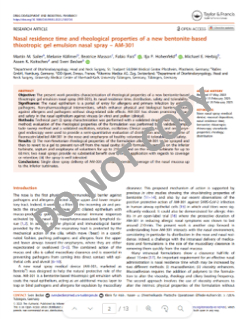 Nasal residence time
Nasal residence time and rheological properties of a new bentonite-based thixotropic gel emulsion nasal spray – AM-301
Drug Development and Industrial Pharmacy
Sailer MM, Köllmer M, Masson B, et al. Drug Dev Ind Pharm. 2023;49(1):103–114.
Read the full study(opens doi.org/10.1080/03639045.2023.2183724 in a new tab)
Request the full study data and references.
Detailed methodology, statistical analyses and peer-reviewed publications are available to healthcare professionals on request.